
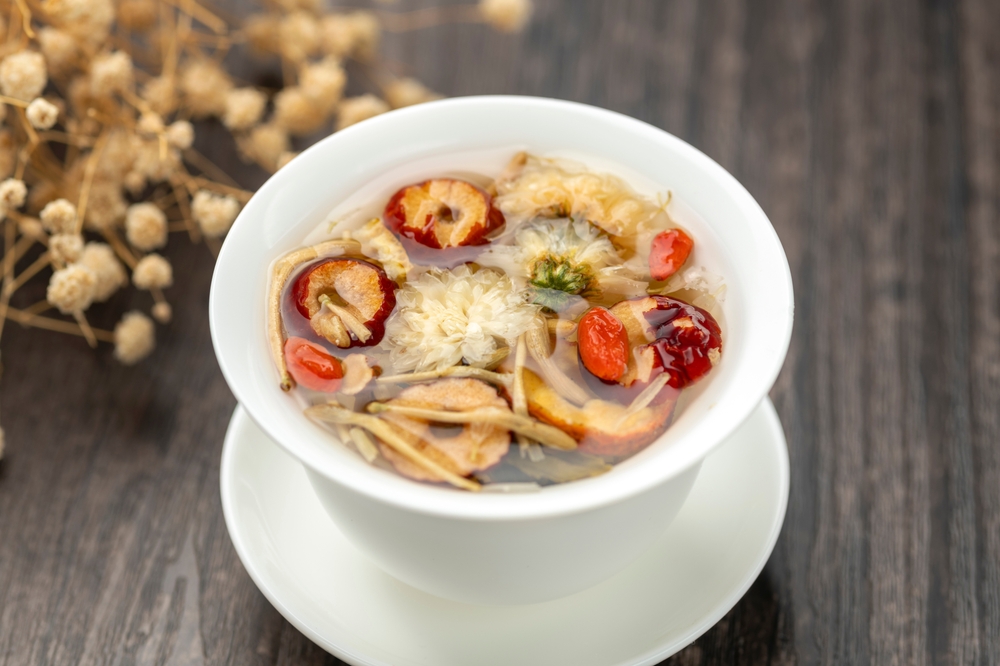
In a teahouse in Ningxia, in the dry northwest of China, the first thing you notice is not the conversation. It is the porcelain. A lid slides against the rim of a bowl, a small scrape, and then another somewhere across the room, as drinkers nudge floating chrysanthemum petals and goji berries aside to reach the tea beneath. That bowl holds Eight Treasures Tea (八宝茶, ba bao cha), and the sound is the sound of patience. This is not a drink you throw back between meetings. It is refilled three or four times throughout the morning, sweetening as it goes, and it has been prepared this way in households in northwest China for generations.
Ask eight families which eight treasures belong in the bowl, and you may get eight answers. That is not sloppiness. It is the point. What follows is the story of where Eight Treasures Tea actually comes from, which is not quite where most articles will tell you. We will look at what goes into the bowl, what traditional Chinese medicine (TCM) asks of each ingredient, what modern research can and cannot support, and how to brew a cup at home.
What is Eight Treasures Tea?
Eight Treasures Tea, or ba bao cha, is a traditional Chinese blend brewed in a lidded bowl. A tea base is combined with sweet and medicinal ingredients, most often goji berries, red dates, dried longan, and chrysanthemum. It is closely tied to the Hui communities of northwest China, where it is drunk daily as a gentle tonic and offered as a welcome. The number itself is more poetry than prescription. Ba bao (八宝), meaning “eight precious” or “eight treasures,” is an old Chinese naming convention that appears across the culinary tradition: eight-treasure congee, eight-treasure duck, eight-treasure soup. Eight signals abundance and completeness rather than a fixed inventory.
So the recipes vary by region, by season, by household, and by whatever the pantry holds. A Ningxia bowl leans heavily on goji berries and chrysanthemum. A Gansu bowl may carry more dried fruit and nuts. Both are correct. This flexibility is worth holding onto, because it explains why no single authoritative recipe exists, and why anyone who insists theirs is the original should be read with a raised eyebrow.
The true history of Eight Treasures Tea (Ba Bao Cha)
Here the story gets tangled, and honesty serves the reader better than confidence. At least three accounts of the origin of Eight Treasures Tea circulate widely, and they do not agree.
The Tang Dynasty claim and what the records show
The most repeated account traces Eight Treasures Tea to the Tang Dynasty (618-907 CE), giving it a lineage of more than 1,300 years. Chinese state media has described traders along the northwest routes brewing local specialties together, each contributing something from home, to ease fatigue and build trust with strangers on the road. It is a lovely image, and something like it is almost certainly true in spirit. Tea with things added to it- dates, spices, dried fruit- is very old. The Tang was also when tea drinking became an everyday habit rather than a monastic or medicinal one. However, it is much harder to establish a straight line from a Tang caravan cup to the specific gaiwan blend served in Ningxia today. Treat the 1,300 years of Eight Treasures Tea as heritage rather than documentation.
Nspirement has told the broader story of the legendary Silk Road elsewhere, and this tea belongs to it: not to an abstract “ancient China,” but to a specific corridor of movement, exchange, and arrival.
Tea of the Northwest: The Hui and Dongxiang
The most grounded answer is also the most specific. Eight Treasures Tea, as it is actually drunk today, belongs to the Muslim communities of the northwest. Above all, it belongs to the Hui of the Ningxia Hui Autonomous Region and neighboring Gansu, and to the Dongxiang, descendants of 13th-century Mongols who converted to Islam. There, the drink carries another name: sanpaotai (三炮台). It is served in a covered bowl, refreshed through the day, and pressed on guests the moment they sit down. In Ningxia it is spoken of as a cup of shared identity, a small daily ritual that different peoples along the old trade corridor hold in common.
A local saying captures the rhythm of it: one cup in the morning brings a day’s vigor, one cup as afternoon tea makes work feel light, and one cup in the evening refreshes and soothes. This is the part most English-language accounts skip, and it matters most. Eight Treasures Tea is not an artifact recovered from a dynasty. It is a living practice, poured this morning, in kitchens and teahouses, by people who would be surprised to hear it called ancient.
The Empress Dowager and the herbalist
A third account places the invention in late-Qing Beijing, where the Empress Dowager Cixi is said to have asked her physicians for a tonic safe enough to drink every single day. The herbalist chosen for the task selected a small quantity of eight herbs, balanced so the blend would neither overheat the body nor cool it too far. Whether this happened is unknown. It has the tidy shape of court legend, and it survives because it is a good story. Enjoy it as one.
A note on Li Shizhen
Many articles about Eight Treasures Tea, including the earlier version of this one, state that the great Ming physician Li Shizhen (1518-1593) revised the recipe, changing some ingredients and adding others. That claim is repeated widely. We have not found documentary support for it. Li Shizhen was real and monumental. His Bencao gangmu (Compendium of Materia Medica), completed in 1578, described 1,892 substances and set out directions for roughly 11,000 prescriptions, according to Britannica. It remains one of the towering achievements of Chinese medicine. Nevertheless, an often-repeated attribution is not the same as an attribution evidenced. We would rather tell readers what is known than pass along a pedigree we cannot verify.
Sanpaotai: The cup that holds heaven, Earth, and humanity
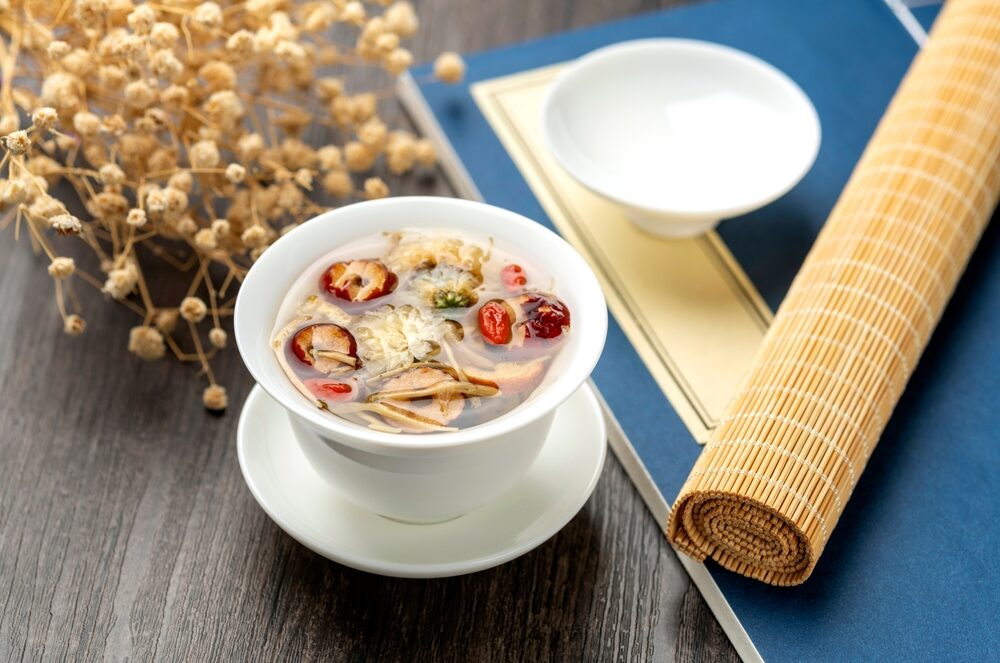
The vessel is not incidental to Eight Treasures Tea. It is half the meaning. A sanpaotai, better known outside the region as a gaiwan, comes in three pieces: a lid (gai), a bowl (wan), and a saucer beneath (tuo). The name has been read as “three forts” or “three cannon shots,” after the stacked silhouette. However, the reading that has traveled furthest is cosmological. The lid is heaven, covering. The saucer is earth, bearing. The bowl between them is humanity, held and nourishing. You do not need to believe any of this to enjoy the tea. But it is a small and beautiful piece of design philosophy, and it is entirely characteristic of how ancient Chinese teaware encoded ideas about the world into objects meant for daily use.
How to drink it
The lid does real work. Because the ingredients float, you tilt the lid slightly and use its edge to sweep petals, berries, and dates back from the rim, then sip through the gap. That is the scraping sound that fills a Ningxia teahouse. Then you refill. Eight Treasures Tea rewards this: hot water goes back over the same treasures three or four times through the day. The first steeping is light and floral. By the third, the dates and longan have surrendered their sugars and the cup has turned rounder and sweeter. Many drinkers eat the rehydrated fruit at the end, which is the most satisfying part of the ritual and the one nobody warns you about.
The Eight Treasures: What goes in and why
The ba bao cha ingredients below reflect a common Ningxia-leaning blend, with the traditional role TCM assigns to each one:
| Treasure | Chinese | Traditional TCM Role |
|---|---|---|
| Green or jasmine tea | 绿茶 / 茉莉花茶 | The base; clears heat and lifts the spirit |
| Goji berries | 枸杞 gouqi | Tonifies Liver and Kidney yin; brightens the eyes; builds blood |
| Red dates (jujube fruit) | 大枣 dazao | Tonifies Spleen qi; nourishes blood; calms the spirit |
| Dried longan | 桂圆 guiyuan | Nourishes Heart blood; calms the spirit; supports memory |
| Chrysanthemum | 菊花 juhua | Clears Liver heat; brightens the eyes; disperses wind-heat |
| Dried hawthorn | 山楂 shanzha | Resolves food stagnation; moves blood; supports digestion |
| Rock sugar | 冰糖 bingtang | Harmonizes and softens the blend; gentle Spleen support |
| Sesame or sunflower seeds | 芝麻 zhima | Nourishes essence; adds richness and body |
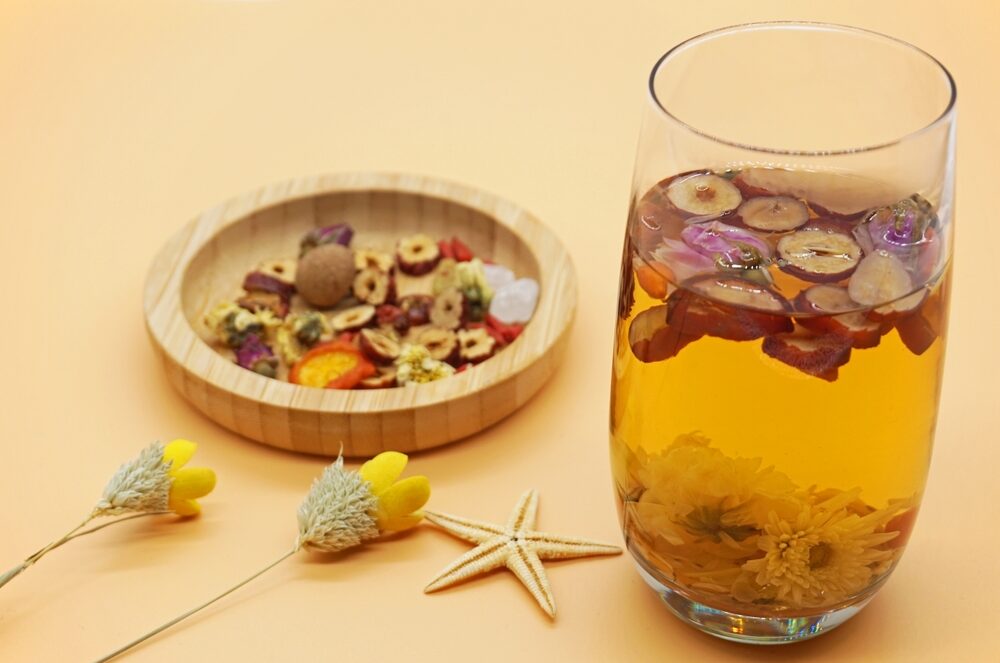
In addition, regional and household variations swap in rose buds, licorice root, American ginseng, orange peel, astragalus, raisins, walnuts, or dried apple. Two of these treasures carry enough weight to have earned their own study. One is the small red goji berry, prized for the kidneys and the eyes. The other is the chrysanthemum flower, whose cooling, calming qualities make it one of the most-drunk single-herb teas in China.
Eight Treasures Tea benefits in traditional Chinese medicine
In TCM, Eight Treasures Tea is not understood as eight separate remedies sharing a bowl. It is read as a single formula, assembled so that the parts balance each other. The following describes how the tradition frames the tea. It is not a claim of medical outcome, and none of it should replace advice from a qualified practitioner.
Tonifying qi and blood
Red dates and longan are the workhorses here. In TCM, red dates tonify Spleen qi and nourish blood, while longan nourishes Heart blood. With the warmth of the tea base, the blend is traditionally taken as a daily restorative, especially in cold weather, during recovery, and for those who tire easily.
Nourishing liver yin and brightening the eyes
Goji berries and chrysanthemum form one of the most familiar pairings in Chinese herbal practice. Goji is used to tonify Liver and Kidney yin; chrysanthemum to clear Liver heat. Both are traditionally described as brightening the eyes. For a reader who spends nine hours a day looking at a screen, this pairing is the reason Eight Treasures Tea keeps finding new drinkers a thousand years after the first bowl.
Calming the spirit
Longan and red dates are both said to calm the shen, the spirit or consciousness that TCM houses in the Heart. The tradition connects this to easier sleep, steadier mood, and relief from the low-grade agitation of a tiring week. Moreover, rose buds, when included, serve much the same purpose.
What modern research says
Here we should be careful, because this is precisely where wellness writing tends to overreach.
The goji evidence is real, and modest: Goji berries contain the highest known concentration of zeaxanthin of any food. Zeaxanthin and lutein accumulate in the macula, the central retina, where they help filter blue light. A randomized pilot trial found that regular goji berry intake increased macular pigment optical density in healthy adults. A separate 12-month study reported that Lycium barbarum supplementation delayed cone degeneration in people with retinitis pigmentosa. These are small studies, not proof that drinking tea protects your eyesight. Nevertheless, it is striking that a tradition reaching for “brightens the eyes” landed on the single most zeaxanthin-dense food on the planet.
The jujube evidence is about a different plant part: This distinction gets lost constantly, and it matters. Research on jujube for sleep and anxiety, including studies on jujubosides and GABA signaling, focuses on the seed of the sour jujube (酸枣仁, suanzaoren). That seed is a distinct medicinal with its own long history of quieting restless minds. Eight Treasures Tea contains the red date, the fruit (大枣, dazao). They are not interchangeable, and studies of one cannot support claims about the other. Anyone citing sleep trials to sell you this tea has not read the papers.
The evidence for longan is preliminary: So far, research on longan and cognition has been conducted in animal models. It is genuinely interesting. It says nothing yet about what happens in people. So, the honest summary is this: Eight Treasures Tea is a pleasant, low-caffeine, warming drink, made largely of ingredients with respectable nutritional profiles. Behind it is a tradition that has been used on people for a long time. That is a reasonable thing to drink. It is not medicine, and the tradition itself never asked it to be. It asked it to be daily.

How to Make Eight Treasures Tea at home
This Eight Treasures tea recipe is forgiving, and you can adjust the proportions. Start here, then adjust to your own taste over a week.
The gaiwan method
- Briefly rinse the dried ingredients under cool water.
- Into a 250 to 300 ml lidded bowl, add one teaspoon of green or jasmine tea, a tablespoon of goji berries, three or four halved red dates, five or six dried longan, four or five chrysanthemum flowers, a few hawthorn berries, a teaspoon of seeds, and one small piece of rock sugar.
- Pour water at approximately 85-90°C over the top. Cover.
- Steep for five minutes.
- Tilt the lid, sweep the floating ingredients aside, and sip through the gap.
- Refill with hot water three or four times through the day, letting it grow sweeter.
- Eat the softened dates and longan at the end.
The pot or mug method
If you have no gaiwan, you can still make Eight Treasures Tea in a pot. Simmer everything except the tea leaves in a small pot of water for eight to 10 minutes, until the dates release their sweetness. Brew the tea separately, a little stronger than usual, then strain it into the pot. This is the method the original version of this article recommended, and it remains a good one, especially when serving several people.
A mug with a saucer on top works too. It is not ceremonial, but the tea does not mind.
Who should be careful
Eight Treasures Tea is gentle by design, which is precisely why it was built to be drunk every day. Still, a few readers should approach Eight Treasures Tea with care:
- If you are managing blood sugar, reduce or omit the rock sugar. Dates and longan carry their own sugars.
- If you are pregnant, consult your doctor before drinking herbal blends. Hawthorn in particular is usually reduced or avoided.
- If you take anticoagulants such as warfarin, speak with your physician first, as some ingredients may interact.
- If you are sensitive to caffeine, note that the tea base contains some, though far less than a cup of coffee. Reduce the leaf or steep it separately.
- During an acute fever, tradition calls for setting aside warming tonics until the illness passes.
- Older readers should pay attention to timing and strength, brewing the leaf lighter and drinking earlier in the day.
None of this is unusual advice. It is simply the caution any thoughtful herbalist would offer, and it belongs alongside the recipe rather than in a footnote. For more traditional wellness practices, explore Nspirement’s Chinese health tips.
A cup made for strangers
Strip away the dynastic claims and the competing origin stories, and what remains is remarkably durable. Eight Treasures Tea was assembled by people in motion, on a corridor where nobody was from anywhere nearby. Each traveler contributed something from home. Goji from one valley, dates from another, tea carried a thousand miles. What came out of the bowl belonged to none of them and all of them, and it was pressed into the hands of the next stranger who sat down.
Four things worth carrying away about Eight Treasures Tea. The number eight is symbolic, so your blend is not wrong. The tea belongs to the Hui and Dongxiang communities of the northwest, not to a vague antiquity. The goji research is real, the jujube research is about a different plant part, and the difference is worth knowing. And the lid is heaven, the saucer is earth, and what sits between them is you.
There is something quietly hopeful in a drink invented to make strangers less strange. Eight Treasures Tea asks almost nothing of you: some hot water, a few dried things, and the willingness to sit with it long enough to be refilled. In a century that rewards speed, a cup that improves on the third steeping is making an argument. Tomorrow morning, set eight small things in a bowl, pour the water, and wait. That is the whole practice. Brew your Eight Treasures Tea slowly, and offer it to someone.
Follow us on X, Facebook, or Pinterest
