
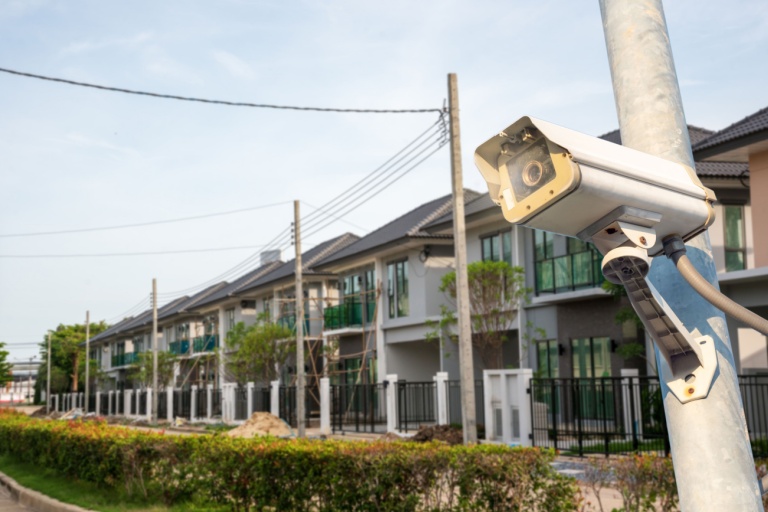
At first glance, it looks like something from a sci-fi film — a small, black gun turret mounted under the eaves of a suburban house, its lens glinting under the South African sun. But this isn’t a weapon of war; it’s a symptom of fear. In neighborhoods where the night hums with alarms and the police may never come, ordinary people are wiring their homes with remote defense turrets that fire plastic rounds on command — tools meant to protect without killing, to comfort without trust. It’s a strange kind of progress: the dream of safety reborn as automation, where technology doesn’t just watch over us, but decides who belongs on the other side of the wall.
Where safety turned electric: Home security in South Africa
In the gray dawn of Johannesburg’s northern suburbs, the skyline glints not with steel and glass but with wire — coils of electric fencing tracing the edges of every property, their metal barbs catching the morning light. Behind them, dogs bark in chorus and cameras twitch awake. It’s an architecture of anxiety: homes that look like bunkers, driveways that feel like checkpoints. And lately, something new has joined the arsenal — a remotely operated gun mounted under the eaves of a house.
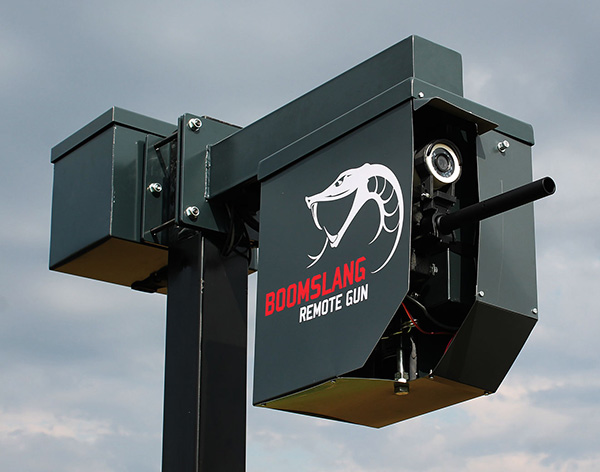
To the uninitiated, it looks like a dystopian prop: a squat, black turret that swivels on command. But in parts of South Africa, where residents have learned to live with daily reports of carjackings, armed break-ins, and police stretched thin, it’s a tool of reassurance. Known as a “remote defense turret,” the system doesn’t fire bullets but .68-caliber plastic or pepper rounds, similar to paintball ammunition — rounds that hurt, bruise, and sting, but do not kill.
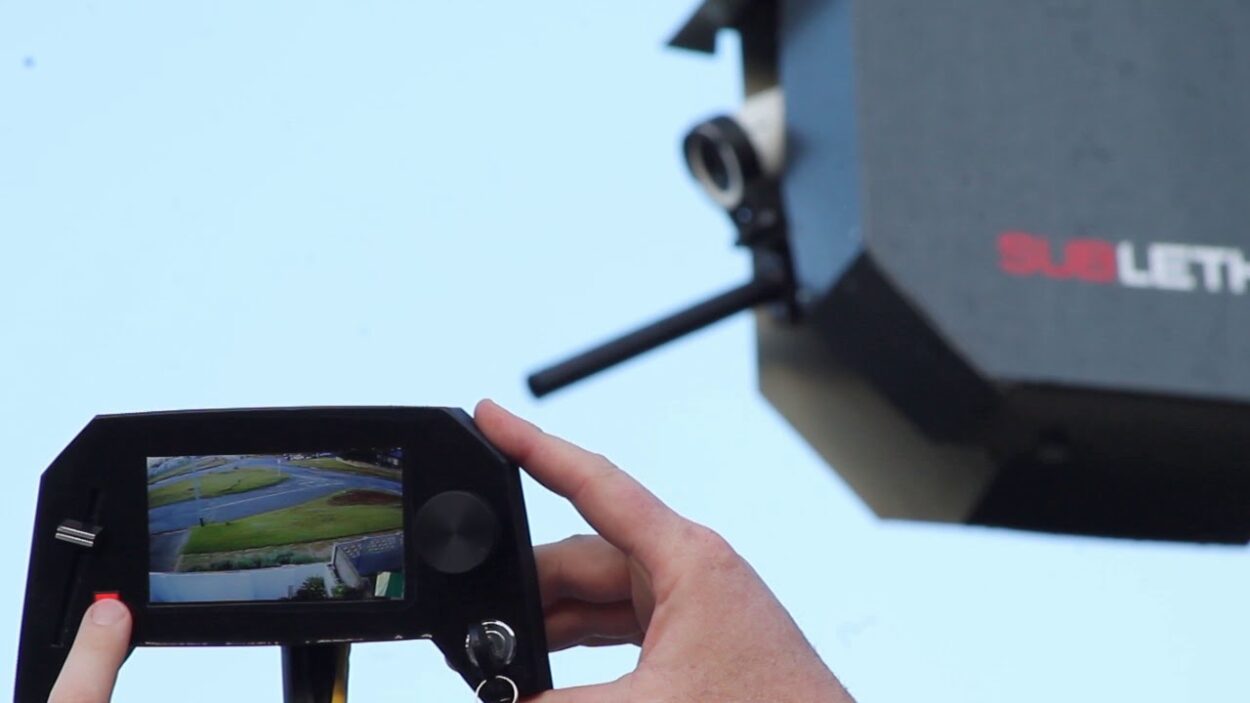
It’s controlled through a smartphone app or control-room console, streaming a live camera feed. If the system detects movement in a restricted zone, it can send an alert, allowing the homeowner or security operator to rotate, aim, and fire remotely. The most popular brand, Sublethal Defense, markets it as “a non-lethal deterrent designed for instant threat response.” And because it doesn’t use real bullets, it requires no firearm license. In a country where private security already outnumbers the police by nearly three to one, the turret is simply the next evolution — the endpoint of a decades-long retreat into fortified living.
A weapon that doesn’t kill — and doesn’t need a license
On paper, the system sounds almost responsible: a compromise between the right to self-defense and the moral burden of lethal force. But the simplicity of that promise conceals layers of legal and ethical complexity.
Under South African law, self-defense hinges on proportionality — you may use force to protect yourself, but only if that force is reasonable and necessary at the moment of threat. “Even a non-lethal weapon can land you in trouble if you use it excessively,” warns a Cape Town–based legal expert interviewed in MyBroadband’s feature on the devices. “If someone is running away and you keep firing, the courts won’t care whether it’s rubber or lead.”
Yet demand is rising. The past five years have seen an explosion in private home tech defenses, from electric fences and motion lasers to AI-linked CCTV and “panic response” drones. Sublethal Defense claims its systems are being installed in Johannesburg, Durban, and parts of the Western Cape, where violent crime rates remain among the world’s highest.
For many, it’s not about vengeance — it’s about distance. The turret allows people to act against a perceived threat without stepping outside, without seeing the intruder’s face, without the adrenaline and panic that can turn defense into tragedy. “It’s a safety buffer,” one security contractor explained in a Reddit AMA. “You can respond before they reach your door.” Still, distance has its own risks. Ethical ones.
The psychology of living behind walls
The sociologist Richard Ballard once described Johannesburg as a city “built on the fear of strangers.” Drive through Sandton or Houghton, and you can feel it — the invisible geography of trust and distrust mapped in walls and gates. Over time, those physical barriers have shaped not just how people protect their homes, but how they imagine safety itself.
When safety becomes something you buy, install, and automate, it shifts from a shared civic concern to a private possession. The “techno-fortress” home — a concept explored in urban design journals over the past decade — embodies that change. It’s no longer just security; it’s status, a statement that says: I can afford to keep danger out.
And yet, paradoxically, the more sophisticated the defenses, the more pervasive the anxiety seems to grow. A 2023 study from the Institute for Security Studies found that residents of gated communities often report higher perceived risk than those in less secure areas. Safety, it turns out, is not just about barriers — it’s about belonging.
That psychological paradox underpins the spread of remote turrets. They symbolize a kind of technological control, a reclaiming of agency in a society where trust in institutions is threadbare. But they also reinforce the idea that the only reliable response to insecurity is isolation — that you’re on your own, your safety mediated by code and camera.
In the townships and informal settlements where such devices are unaffordable, the divide is more than symbolic. It’s physical: a gulf between those who can fortify and those who must rely on collective watchfulness, neighbors, and the overstretched police. The turret thus becomes not just a tool of security, but a mirror of inequality — a device born of both fear and privilege.
Between deterrence and danger: Ethics on the trigger
When footage of a “robot turret” went viral on X (formerly Twitter) in early 2024, thousands of users assumed it was an autonomous weapon. “AI kills in Johannesburg!” one caption screamed. In truth, most systems on the market still require a human operator to pull the trigger. The manufacturer insists the device does not auto-fire — the automation is limited to detection and alerting.
But the fear of automation — of a machine deciding when to inflict pain — is not unfounded. Experimental models from Europe and the U.S. already test AI-aimed paintball cameras designed to deter trespassers. Critics call them a step toward algorithmic vigilantism. What happens when the software mistakes a courier, a cat, or a child for a threat?
Even without AI, mistakes are possible. A Johannesburg homeowner told News24 that his turret “fired two rounds into the night” after a branch triggered the motion sensor. He laughed it off, but others worry about escalation — what if a startled intruder fires back with real bullets?
That’s the moral tension at the core of the turret boom. It tries to make violence safe, to sanitize the act of harm. The system promises to hurt without killing, but hurt is still the point. “Non-lethal” is not the same as “harmless.” Medical research on pepper-ball injuries shows risks of blindness and permanent scarring. The ethical line, then, is not about lethality but intent — whether harm becomes routine, mechanized, and normalized in the name of security.
Philosopher Susan Sontag once wrote that “a photograph is a moral choice framed.” A remote turret’s camera feed is the same — every frame demands a decision, every trigger pull a judgment call about who deserves pain. The difference is that now, that choice happens through glass and Wi-Fi, one layer further removed from the humanity of the target.
Can technology make us feel safe — or only more alone?
The deeper question is not whether these turrets work — they often do deter break-ins — but what they do to the people who live with them. In interviews and online forums, owners describe the thrill of empowerment: “I can see everything. I can act before they do.” Yet in quieter moments, some admit a kind of disquiet. The device sits above the porch, a silent reminder that they live in a world where even peace requires a trigger mechanism.
Across the globe, similar patterns are emerging. In Brazil, middle-class families install facial-recognition gates and automated laser deterrents; in Los Angeles, private security drones patrol gated estates. In each case, technology promises control — but control without trust often feels hollow.
In South Africa, where inequality and crime intertwine, the turret is not an aberration; it’s an adaptation. It’s a response to systemic failure — of policing, governance, and collective safety — distilled into hardware. But the danger lies in mistaking that adaptation for a solution. A true sense of safety rarely comes from domination, even of a non-lethal kind. It comes from community, connection, and accountability — things no app or camera can replicate. The turret might keep intruders at bay, but it also keeps the neighbors out. The irony is hard to miss: a nation that once fought to tear down walls now finds safety in building smarter ones.
Conclusion: The future of defense or a symptom of fear?
The remote turret is both ingenious and unsettling — a piece of engineering that reveals as much about psychology as it does about technology. It’s a machine built to defend the self in a society where collective protection feels broken. It reflects a global trend toward privatized safety, where defense becomes a subscription, and vigilance a lifestyle.
South Africa’s “techno-fortress” homes are not the end of the story; they’re the beginning of a broader question that will confront societies everywhere: What happens when safety becomes automation, and fear becomes a market?
If the 20th century was the age of public policing, the 21st may be the era of personal fortresses — sleek, networked, and morally ambiguous. And when the hum of the turret joins the nighttime symphony of alarms and barking dogs, it hums not just of protection, but of something more profound: a quiet surrender to the idea that being safe means being alone.
Follow us on X, Facebook, or Pinterest
