
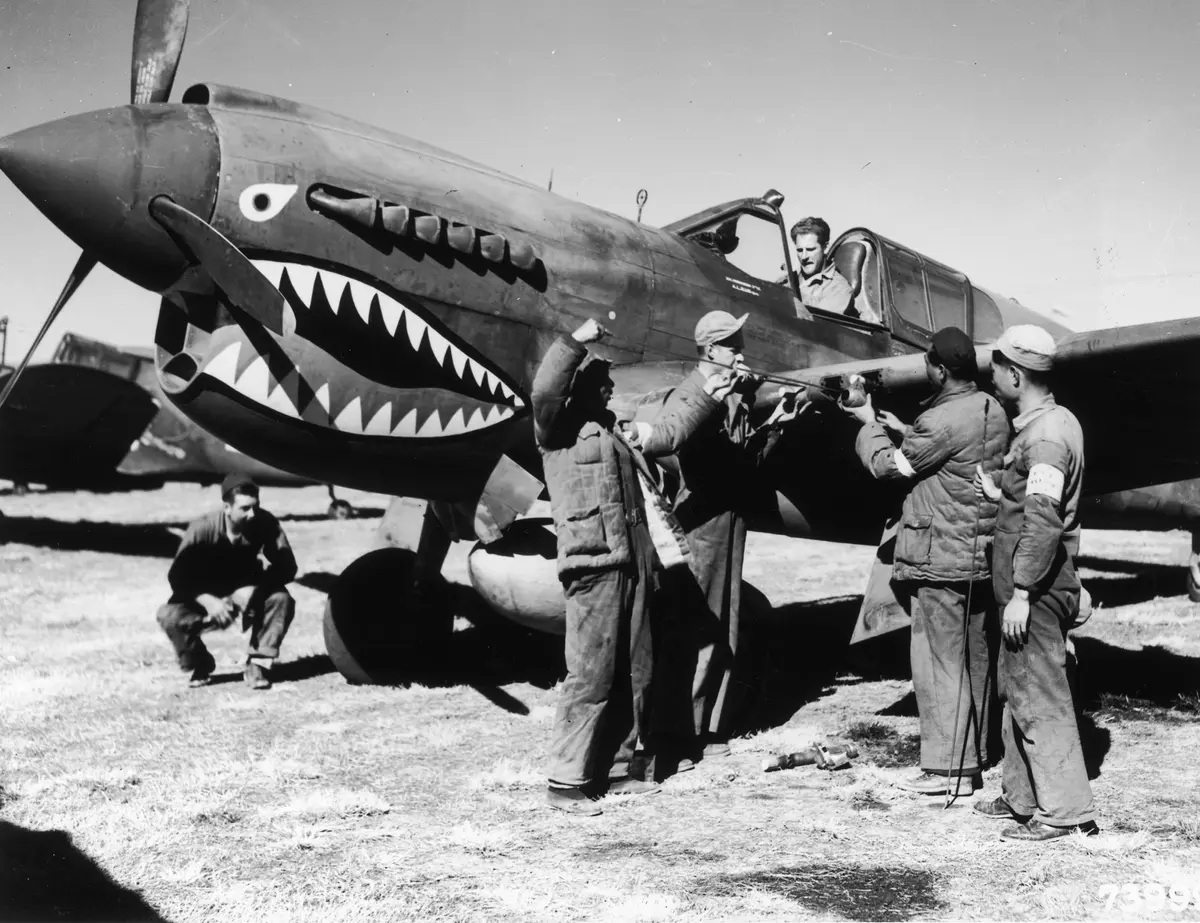
Many Chinese are familiar with the American “Flying Tigers.” Its official name was the “American Volunteer Group of the Republic of China Air Force,” an air force unit composed mainly of American pilots that aided China in its war of resistance against Japan during World War II, primarily fighting in mainland China and Burma. The volunteer group was led by retired American flight captain Claire Chennault. In 1941, with President Roosevelt’s support, he obtained 100 aircraft from the United States under the Lend-Lease Act and recruited 100 pilots.
Initially, some members of the volunteer group suggested painting a shark’s head on the nose of their fighter planes as a psychological warfare tactic to intimidate the Japanese forces. In December 1941, the air corps achieved its first combat victory in the skies over Kunming. Residents in interior China mistakenly called the planes “Flying Tigers” because they had never seen a shark. ”
The following day, a Kunming newspaper used the term “Flying Tigers” to describe the volunteer squadron’s aircraft. The Chinese translator in the air force, upon seeing this, translated it as “Flying Tigers” and told Chennault about the name. The squadron members thought it was good, and so the air force was officially named the “Flying Tigers.” The story of a father and son, officers of the “Flying Tigers,” is recorded in the book Prison Notes written by the late Wang Xuetai, a researcher at the Chinese Academy of Social Sciences.
This officer was Peng Jiaheng, formerly known as Peng Huaiqing. His ancestral home was Xingning, Guangdong, but he was born in Pontianak, Indonesia. In 1936, he returned to China and studied at Xingning No. 1 Middle School in Guangdong. In 1937, he wanted to join the military but was underage and lacked the required educational credentials. So he used the identification and high school diploma of his fellow townsman, Peng Jiaheng, to apply to the 17th class of the Whampoa Military Academy of the Republic of China and was finally admitted to the Overseas Chinese Corps. In 1938, he joined the Transportation Corps of the 4th Army Group of the National Revolutionary Army.
Peng Jiaheng entered the Central Military Academy in 1940, studied at the Central Aviation School in 1941, and received training at the Phoenix Advanced Flying School in the United States in 1942. After returning to China in 1944, he joined the Flying Tigers, completing 64 combat missions against Japan. He is the only pilot from mainland China to receive the U.S. Distinguished Flying Cross.
In 1947, Peng Jiaheng retired from the military and returned to Indonesia after refusing to participate in the civil war. In 1950, after seeing news in the newspapers about the defection of the Republic of China’s two airlines to the Communists, and lacking a clear understanding of the CCP, he voluntarily entered the clutches of the Communists, returning to China to work at the Civil Aviation Administration of the Central Military Commission as a co-pilot. In 1954, he was officially appointed captain, training pilots for the Communist army. At the same time, he married his girlfriend, whom he had met during the late stages of the War of Resistance against Japan.
Over the course of more than a decade, Peng Jiaheng flew various important and dangerous missions, including charter flights, escort duties, mining operations, and forest protection, accumulating over 7,000 flight hours. With such qualifications, becoming a high-ranking general in the CCP Air Force should have been a given. However, given his overseas Chinese status and background working for the Republic of China and the United States, this was clearly impossible, and he naturally couldn’t escape the CCP’s iron fist.
Wang Xuetai met Peng Jiaheng’s son, Peng Zhuonan, in prison. In Wang Xuetai’s eyes, Peng Zhuonan was a fearless young man, timid yet bold, with a straightforward personality and a smile like a middle school student. Yet, this very person had been sentenced to 20 years in prison. Why? The charge was a “counter-revolutionary class-retaliation homicide case.” He specifically sought revenge against someone on behalf of his persecuted father, resulting in the person being critically injured.
It turns out that after returning to China, Peng Jiaheng lived a relatively comfortable life in the 1950s. However, after the CCP emphasized class struggle in the 1960s, his life became increasingly difficult. Because of his complicated background, he was frequently asked to make self-criticisms and confessions, and subsequently subjected to control, demotion, and constant criticism and denunciation at meetings large and small.
When the Cultural Revolution began in 1966, Peng Zhuonan was only 7 years old and not fully aware of his father’s ordeal. It wasn’t until he was 16 and in high school that he read his mother’s appeal to higher authorities regarding his father’s years of misunderstanding and injustice, and learned of his father’s tragic experiences. The appeal mentioned that Zhang, the head of the security department at the Capital Airport, had acted particularly badly, persecuting Peng Jiaheng through various means and repeatedly beating him.
After reading it, Peng Zhuonan was furious and sought an opportunity to take revenge on Zhang, whose daughter was his classmate. Although he knew the severe consequences of retaliating against a “proletarian” like Zhang, Peng decided to give it a try anyway.
After planning, Peng secretly took his family’s national food stamps and some money, then treated his close friends to a farewell meal. One day after school, instead of going home, he went straight to Zhang’s house with a kitchen knife. His classmate opened the door. He asked, “Is your dad home?” and she told him that he was in the inner room.
When Peng pushed open the door to the inner room, Zhang was sitting on a small stool reading a newspaper. Peng stepped forward, ripped the newspaper away from Zhang’s face, and sharply demanded to know if he was the one who had beaten his father during the Cultural Revolution. Zhang, likely confused by the situation, did not answer. At this moment, Peng pulled out the kitchen knife and lunged at him. Terrified, Zhang ran around the table, begging for mercy. However, Peng remained completely unmoved, stabbing Zhang four times in succession, with one of the blows striking him on the neck.
After stabbing him, Peng fled. He initially tried to escape, but upon realizing how difficult it would be, he turned himself in at the airport police station. This major case occurred in 1976, before the “Gang of Four’s” arrest; he was not yet 18 years of age.
However, by the time of the trial, the “Gang of Four” had already been arrested, and the Cultural Revolution had ended. This is why Peng was not severely punished, but only sentenced to 20 years; at that time, people were more sympathetic toward those who had been persecuted during the Cultural Revolution. During the CCP’s “rehabilitation” movement launched in 1978, Zhang, who had been seriously stabbed, was found to have ties to the so-called “Lin Biao Gang of Four” group. Peng Zhuonan’s sentence was reduced by more than 10 years, and he was finally released after only a few years in prison.
.
While in prison, Peng was very excited after a visitation day. He told Wang Xuetai: “My parents have never been so good to me! If I had been locked up here for just ‘messing around,’ they would never have come to see me.” His eyes lit up as he spoke. Indeed, what parent wouldn’t love a son who avenges his father?
Thirty-three years later, Wang Xuetai met Peng Zhuonan again. By then, he was over 50 years old and had traveled to many countries, including Japan and Europe. Like his father, he had spent a long time in the United States, earning some money driving long-haul trucks. However, he eventually returned to China.

In September 2005, the 60th anniversary of the end of World War II, Peng Jiaheng received a personally signed letter from then-U.S. President George W. Bush, thanking him for his contributions. Only then did Peng Jiaheng’s contributions to the War of Resistance against Japan become known to the outside world. Peng Zhuonan witnessed and shared in his father’s joy and honor.
In 2009, Peng Jiaheng was diagnosed with leukemia and received a bone marrow transplant from his son. His condition relapsed in 2010, and he passed away in Beijing in August of the same year at the age of 89. Following his father’s wishes, Peng Zhuonan donated the remaining 10,000 yuan from his account.
Peng Jiaheng’s momentary lapse in judgment harmed not only him but also his son. If he had chosen to stay abroad, with his qualifications and talent, he would likely have had a very different life. In hindsight, his life path was a result of his own conscious choice and, as such, impossible to reverse.
Translated by Chua BC and edited by Maria
Follow us on X, Facebook, or Pinterest
