
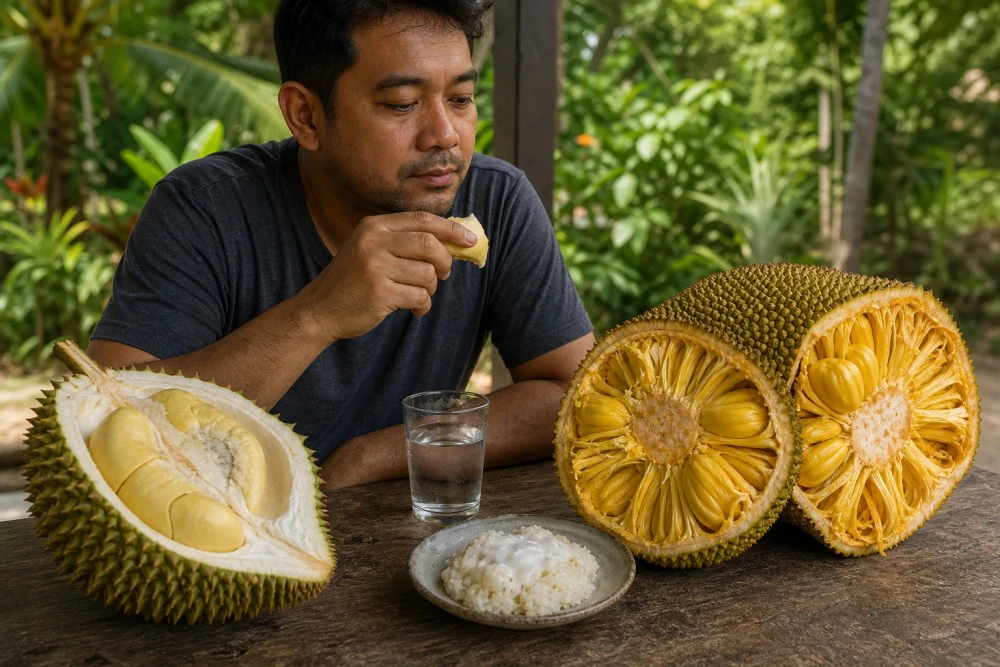
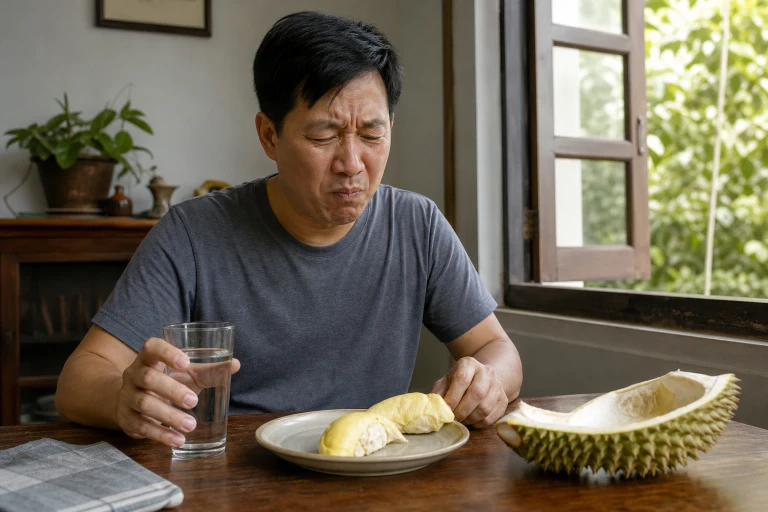
Of all the fruits that look alike on a market table, durian and jackfruit may have confused the most first-time buyers. Side by side, durian and jackfruit pass for prickly green cousins, yet only one can take you from delight to the edge of nausea in a single mouthful. I know, because it happened to me. My first bite of durian was extraordinary: fruity, sweet and creamy, like a custard that had decided to become a fruit. A few seconds later something rose from the back of my throat, my stomach turned, and I was reaching for water, fighting the urge to gag. My first thought was the saddest one I could think of. Maybe I am allergic to it.
I wasn’t. What happened has a chemistry, a name, and a surprisingly long paper trail, and it is one of the most common first meetings with the fruit Southeast Asia crowns as its king. Understanding it changes how you eat durian, and how quickly “never again” turns into “just one more.”
Why a sweet first bite can turn into a gag
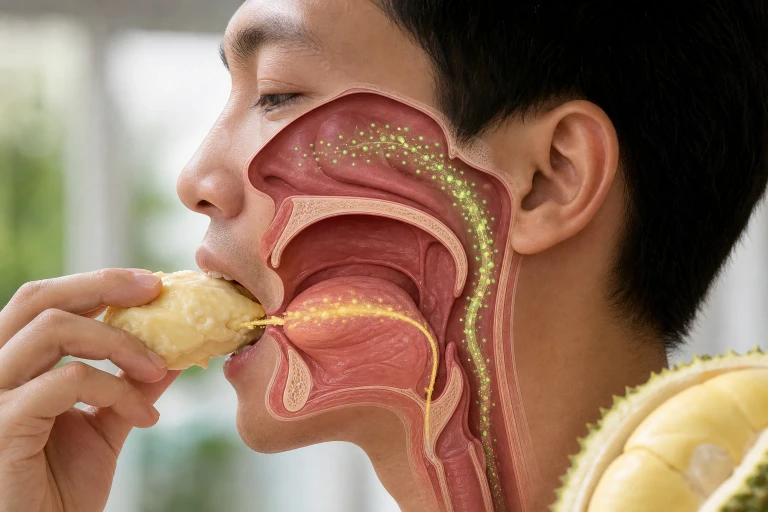
Durian’s flavor does not arrive all at once. It arrives as two messages traveling by different roads. The sugars and fats land on the tongue immediately, and the tongue reports what it knows: sweet, rich, smooth. The aroma takes the back route. As you chew and breathe out, volatile molecules rise from the back of the mouth into the nasal cavity, a pathway called retronasal smell, where much of what we call flavor is actually decoded. That small delay is why the custard comes first and the second act lands a few heartbeats later.
Researchers at the German Research Center for Food Chemistry in Freising took apart what lands in that second act, molecule by molecule. Jia-Xiao Li, Peter Schieberle, and Martin Steinhaus first screened Thai Monthong durian pulp and identified 44 odor-active compounds. In a 2017 follow-up, they measured the most potent ones and found an unusual hierarchy: a fruity ester at the top, followed by ethanethiol, which smells of rotten onion, and 1-(ethylsulfanyl)ethane-1-thiol, which smells of roasted onion. Then came the surprise. Most foods need ten to twenty compounds to imitate their aroma convincingly. Durian needed only two: the fruity ester and the roasted-onion thiol, mixed at their natural concentrations.
The numbers explain the intensity. Odor activity values above 100,000 are rarely recorded in any food. The fruity ester in durian scored 1.7 million, while the same compound in a Haden mango scored about 2,100. The genome explains the source. When a team in Singapore sequenced the Musang King variety in 2017, they found that durian had multiplied its methionine gamma lyase genes, which are tied to producing volatile sulfur compounds, and that these genes switch on strongly in ripening fruit.
So here is a fruit shaped by nature to taste like dessert and to announce itself like cooked onion. For a brain meeting that combination for the first time, the sulfur note reads as a warning that food has turned. Disgust, the ancient reflex that keeps us from swallowing what might be spoiled, does exactly what it was built for. It tightens the throat and turns the stomach. That is the gag. It is a verdict from your nose, not a reaction from your immune system.
The difference is usually easy to see. An aversion peaks and fades within moments once you swallow, sip water, and get some fresh air. An allergic reaction tends to build instead: itching or tingling in the mouth or throat, swelling of the lips or tongue, hives, wheezing or dizziness. Doctors describe durian allergy as rare, though they note it can develop later in life. Any of those signs is a reason to stop eating and seek medical help, not to push through.
The sweetness and the onion arrive in the same bite. They simply reach the brain through different doors.
Durian and jackfruit are not the same fruit
Both are large, green, and studded; both grow in the same tropical belt; and both sit side by side in Asian grocery stores far from home. But they are not even botanical relatives. Durian, Durio zibethinus, belongs to the mallow family. Its genome shares ancient duplication events with cotton, and its closer kin include okra and cacao. Jackfruit, Artocarpus heterophyllus, belongs to the mulberry family, a cousin of the fig and the breadfruit, and probably first grew wild in the rainforests of India’s Western Ghats. Durian’s homeland lies across the sea, in Sumatra and Borneo.
Your hands can tell them apart in seconds. A durian is armored in hard, sharp spines and rarely grows much larger than a football. A jackfruit is covered in blunt, hexagonal knobs and is the biggest fruit any tree bears, reaching up to 90 centimeters long and around 50 kilograms. Inside, durian opens into a few chambers that cradle soft, pale-yellow pods. Jackfruit holds hundreds of firm, waxy golden bulbs, tucked between fibrous strands and a sticky white latex.
Jackfruit has its own smell. The tropical-fruit authority Julia Morton recorded that a fully ripe, unopened jackfruit can give off a strong odor reminiscent of decayed onions, while the opened pulp smells of pineapple and banana. The difference lies in where the heavy note lives. In jackfruit, it stays largely in the rind you throw away. In durian, it lives in the flesh you put in your mouth. That is why jackfruit, with its flavors of banana, mango, and something close to bubblegum, so rarely provokes the reflex that durian does.
Chinese records describe my experience with uncanny precision. Ma Huan, the interpreter who sailed with Admiral Zheng He’s fleets in the early 15th century, wrote in his travel record Yingya Shenglan of a “stinking fruit” in northern Sumatra that smelled like rotten beef, yet held fourteen or fifteen chestnut-sized pieces of soft white flesh that were, as he put it, very sweet and good to eat. A popular legend claims Zheng He named the fruit liúlián, echoing a phrase for being reluctant to leave, because his homesick sailors forgot home after tasting it. The name actually comes from the Malay word durian, from duri, meaning thorn, borrowed into Chinese through the dialects of southern Fujian. The legend is a folk embellishment, but it captures something true about the fruit’s grip.
Jackfruit’s Chinese name carries a different kind of depth. Bōluómì is also written with the very characters Buddhist scriptures use for pāramitā, the perfections a practitioner cultivates, often explained as “reaching the other shore.” In Guangzhou, the ancient Temple of the South Sea God is nicknamed the Boluo Temple, and one legend holds that a Tang dynasty envoy from a distant kingdom planted a jackfruit tree there on his journey home. In Thailand’s forest monasteries, monks still boil jackfruit heartwood for hours to make the ochre-brown dye for their robes.
Six centuries ago, a Chinese interpreter wrote that the fruit smelled like rotten beef and tasted wonderfully sweet. He was describing my first bite.
How to approach your first durian, or your second
The most famous Western convert did not love durian at first either. The naturalist Alfred Russel Wallace wrote in The Malay Archipelago (1869) that the smell put him off when he first tried the fruit in Malacca. Later, in Borneo, he found a ripe one on the ground, ate it outdoors, and from that moment counted himself a confirmed durian eater. He described the flesh as “a rich butter-like custard highly flavored with almonds,” with passing hints of cream cheese, onion sauce and brown sherry. His conversion contains most of the practical lessons.
- Start mild. The Thai Monthong variety is widely recommended for newcomers because it smells gentler and its flesh is sweet and mellow. Malaysia’s celebrated Musang King is richer, more bittersweet and more pungent, so save it for later.
- Eat it fresh and in the open. A durian opened in front of you, ideally outdoors, has not had time to fill a room or a plastic tray with its strongest volatiles.
- Serve it cool. Chilled flesh releases its aroma more slowly, softening the second act while keeping the sweetness intact.
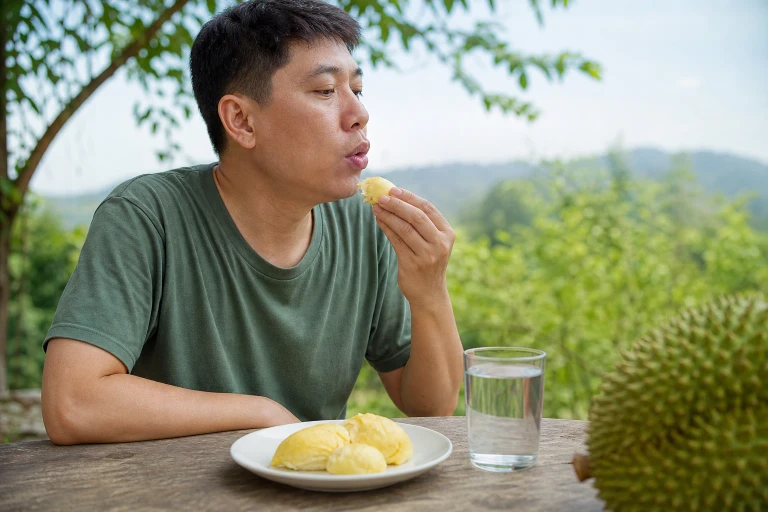
- Take a small bite and manage your breath. For the first few mouthfuls, chew slowly and exhale through your mouth rather than your nose. This narrows the retronasal route that delivers the onion note. Then let your nose join in gradually.
- Use a bridge. Durian spooned over sticky rice and coconut milk, layered onto shaved-ice desserts, or churned into ice cream delivers the flavor in a diluted form, which helps the brain file it under food rather than as a warning.
- Keep water close and alcohol away.
- Then try again soon. Researchers at Sweden’s Karolinska Institutet have found that liking for unfamiliar flavors can be learned surprisingly quickly, even in adulthood, through repeated exposure, especially when people taste attentively rather than while distracted. Each encounter turns the alarm down a notch.
What should you expect? Expect a sweet, creamy opening, followed by a savory, oniony wave, and an aftertaste that can linger for hours, especially with stronger varieties. Many people also feel inner warmth. Traditional Chinese medicine classifies durian as a warming, or “heaty,” food, and its home cultures have their own ways of restoring balance.
How much is safe once you cannot stop
The second danger arrives after the first one passes. Once durian clicks, it becomes hard to stop, and the fruit is energy-dense. A hundred grams of durian flesh carries about 147 kilocalories, 27 grams of carbohydrates, and 5 grams of fat, making it one of the few fruits with a meaningful fat content. A small whole durian (about 600 grams) adds up to roughly 885 kilocalories, close to half an average adult’s daily energy needs.
Regional guidance is remarkably consistent. Dietitians at Singapore’s Changi General Hospital, Mount Alvernia Hospital and Raffles Medical suggest two to three “seeds” per sitting; a seed is one pod of flesh wrapped around its stone, and roughly three make up 100 grams. Khoo Teck Puat Hospital advises people with diabetes to keep it to one or two. Thailand’s Department of Health recommends no more than one or two segments (about 80 grams) a day, on no more than three days a week, and suggests eating durian in the morning or early afternoon rather than before bed.
Alcohol deserves its own warning. In a 2009 Food Chemistry study, researchers at Japan’s University of Tsukuba found that durian extract inhibited aldehyde dehydrogenase, the enzyme that clears a toxic alcohol byproduct, by up to 70 percent in test-tube experiments, most likely because of the fruit’s sulfur compounds. Later animal work pointed the same way. That does not prove the old tales of fatal durian-and-beer nights, but it gives the regional taboo a plausible mechanism, and that is reason enough to keep the two apart.
Some people need extra caution. Durian’s sugar matters for anyone managing diabetes. Its potassium, about 436 milligrams per 100 grams, matters for people with kidney disease, and doctors have reported dangerously high potassium levels in a kidney patient after durian. In one small study, healthy volunteers who ate 500 grams saw their heart rate rise by about ten beats per minute within an hour.
Jackfruit is gentler on the scale, at about 95 kilocalories per 100 grams, and no health authority has set a formal limit. A cup of fresh bulbs, the standard serving, still contains about 31 grams of sugar, so people with diabetes should portion it like any sweet fruit. Jackfruit has been confirmed as a birch-pollen-related food allergy, and in a 2010 study, most patients with birch pollen allergy reacted to jackfruit in skin tests, a relevant detail for anyone in Central or Northern Europe who sneezes through spring. People with latex allergy have also had serious reactions. And never eat jackfruit seeds raw. They contain tannins and trypsin inhibitors, which boiling or roasting deactivates, and they may slow blood clotting, so anyone on blood thinners should eat them sparingly.
The real risk with durian is not the first bite. It is the fifth seed you never meant to eat.
What these two fruits give the body
Eaten with restraint, durian is a remarkably nourishing fruit. A hundred grams provides nearly 4 grams of fiber, a solid dose of potassium, about 20 milligrams of vitamin C, and a notable share of B vitamins, especially thiamin and vitamin B6, along with copper and manganese. Its fats are mainly monounsaturated, the kind dietitians associate with healthier cholesterol levels, and its flesh contains antioxidants such as polyphenols and beta-carotene. Much of the research on those antioxidants comes from laboratory and animal studies, so they are best seen as a bonus rather than a cure. Its glycemic index is about 49, moderate for such a sweet fruit, though portion size matters far more than the index.
The traditional pairings deserve a mention. Across Southeast Asia, people eat durian alongside mangosteen, a “cooling” fruit believed to balance its heat, and many families drink water from the empty husk, sometimes with a pinch of salt. A small study found that husk water cooled the mouth about as much as plain water, and no firm evidence shows that mangosteen cancels durian’s effects. Yet the wisdom beneath both customs is sound: drink plenty, eat something light alongside and know when to stop.
Jackfruit offers a different profile, with plenty of potassium, a good share of vitamin B6, some vitamin C and carotenoids, the pigments behind its golden color. Young green jackfruit has become a celebrated meat substitute in Europe, but it imitates the texture of pulled meat rather than its nutrition, with only around 2 grams of protein per 100 grams. The seeds are the overlooked treasure. Once cooked, they supply plant protein, dietary fiber, and resistant starch.
Three ways locals eat durian
Raw, on its own. This is the purist’s way. In Malaysia’s season, which runs roughly from June to September, buyers choose a fruit at a roadside stall, the seller splits it open on the spot, and they eat it by hand, often with nothing else.
Raw, with company. Thais and Malaysians pair durian with mangosteen, and spoon it over glutinous rice cooked in sweet coconut milk, a dish Malaysians call pulut durian. Dessert stalls crown bowls of cendol or shaved ice with a dollop of fresh flesh. For a newcomer, these are the gentlest doorways in.
Cooked and fermented. When a season produces more fruit than anyone can eat, people salt durian flesh and leave it to ferment for days into tempoyak, a tangy, sour paste. In Malaysia’s Pahang and Indonesia’s Jambi, they simmer it with turmeric, chilies, and lemongrass into gulai tempoyak, a curry of freshwater catfish served with rice. More than 150 years ago, Wallace saw the Dayaks of Borneo preserving salted durian in jars as a relish for rice. Ma Huan said the seeds tasted like chestnuts; locals roast or boil them and eat them as a snack.
Three ways locals eat jackfruit
- Raw, on its own. Ripe bulbs are pulled from the fruit and eaten as is, firm, chewy, and honey-sweet. In Kerala, the fruit’s Malayalam name, chakka, gave English the word jackfruit. Anyone opening a whole one quickly learns the local trick: oil your knife and hands first, or wear gloves, because the latex clings like glue.
- Raw, in a mix. Ripe jackfruit strips find their way into fruit salads and shaved-ice desserts across the region, including the Filipino halo-halo, where the fruit’s honeyed sweetness sits beside sweet beans, jellies and milk.
- Cooked young. Unripe jackfruit is a vegetable in its own right. In Yogyakarta, it becomes gudeg, stewed for hours with palm sugar and coconut milk until it turns deep brown, sweet and tender. In Sri Lanka, young jackfruit, called polos, simmers with roasted curry powder and coconut milk into a beloved curry. The seeds are boiled for 20 to 30 minutes or roasted, then eaten as a snack or added to curries.
Reaching the other shore
Looking back at that glass of water, the gag no longer feels like a verdict against the fruit. It feels like a threshold. Durian keeps its sweetness on the far side of a smell the body reads as danger, and the crossing asks for patience: a milder fruit, a cool morning, small bites, a second try, and the discipline to stop at two or three seeds. Ma Huan crossed it six centuries ago, Wallace crossed it under a Bornean sky, and millions of people cross it every season.
Jackfruit, its gentle neighbor, simply opens its arms. Perhaps that fits a fruit whose Chinese name speaks of reaching the other shore. One fruit welcomes you, while the other asks you to earn it. Both, it turns out, reward the same virtue: enjoy fully, eat with measure, and listen when the body says enough.
Follow us on X, Facebook, or Pinterest
