
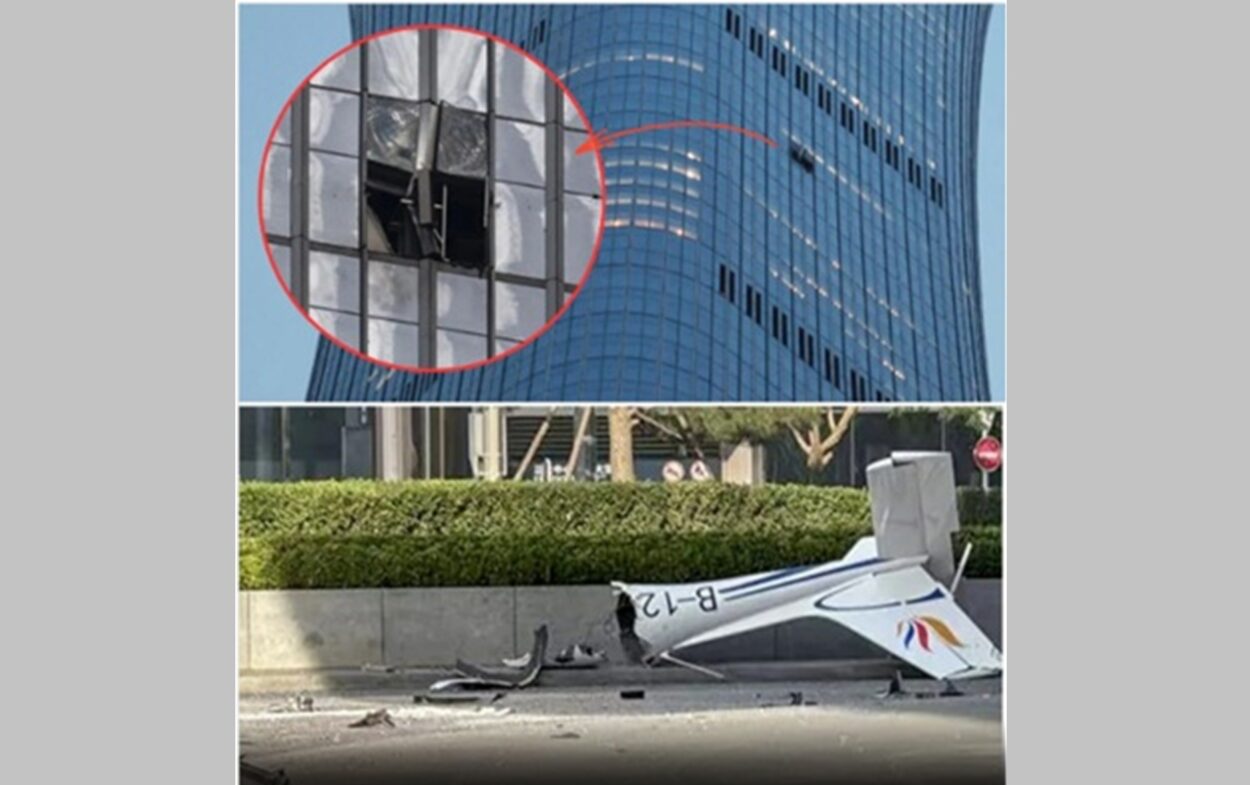
On the evening of June 26, 2026, as Beijing’s evening rush hour was winding down, a Chinese-made Aurora light sport aircraft slammed into the glass façade of China Zun — the nation’s tallest skyscraper, rising 528 meters (1,732 feet) above the capital. The dramatic collision sent shockwaves through international media and ignited intense discussion both inside and outside China. For nearly a week, authorities remained silent. It was not until July 2 that Beijing officials released an explanation.
According to the official account, the pilot was a 66-year-old Beijing resident surnamed Liu, a divorced freelancer who lived alone. He reportedly suffered from chronic insomnia and anxiety and had contemplated suicide on multiple occasions. The government concluded that the crash was “an act endangering public safety caused by personal reasons.” Yet the official explanation immediately prompted skepticism. Was this truly an isolated act by a troubled individual? Or did the incident expose deeper vulnerabilities within a system that prides itself on control? After all, how could a small aircraft fly unhindered into one of China’s most iconic and heavily protected landmarks, located in the very heart of Beijing?
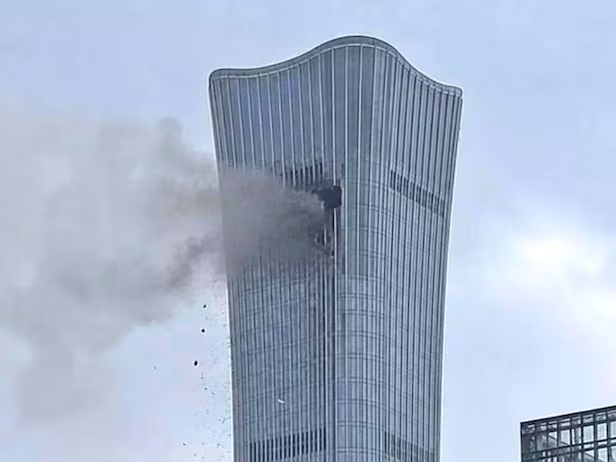
Historical parallels emerge from past Cold War events
When news of the Beijing crash broke, many people immediately recalled the terrorist attacks of September 11, 2001. Yet for those old enough to remember the Cold War, another image came to mind — a remarkable event that unfolded nearly four decades earlier: the famous “Red Square Flight” of 1987. Although separated by thirty-nine years and vastly different political circumstances, the two incidents shared striking similarities. In both cases, a lone pilot in a small civilian aircraft penetrated the airspace surrounding one of the nation’s most important political landmarks. In both, the pilot filed a deceptive flight plan, broke off communication, and continued toward the very center of state power.
The 1987 Red Square flight was far more than an aviation oddity. When a young West German pilot landed his plane beside the Kremlin, the incident stunned the world and exposed weaknesses that many had believed impossible. It became a defining moment in Cold War history, showing how a single unexpected event could reveal cracks in a seemingly invulnerable political system.
An amateur aviator penetrates impenetrable Soviet airspace
It was May 28, 1987. Although the Cold War was entering its final chapter, the Soviet Union remained a military superpower feared around the world. Its vast network of radar installations, surface-to-air missiles, and fighter jets was widely regarded as impenetrable. As the saying went, “Not even a fly could get through.” Yet the person who would pierce this seemingly perfect shield was hardly a seasoned military aviator. He was Mathias Rust, an eighteen-year-old amateur pilot from West Germany with barely fifty hours of flying experience.
His motivation was almost disarmingly naïve. Rust believed he could build “an invisible bridge” between East and West, easing Cold War tensions through one daring solo flight. He spent two weeks preparing for the journey. His route first took him to the Faroe Islands, then to Iceland, where he stayed overnight. There he deliberately visited the site of the previous year’s Reykjavík arms-control summit between President Ronald Reagan and Soviet leader Mikhail Gorbachev. Although the talks had ended without an agreement, Rust regarded the location almost as a personal pilgrimage — a quiet moment to strengthen his resolve. From Iceland he continued through Norway before arriving in Helsinki, Finland, where he made his final preparations.
At noon on May 28, Rust took off from Helsinki-Malmi Airport in a rented Cessna 172, a modest single-engine aircraft capable of flying just over 200 kilometers (125 miles) per hour. To extend its range, several passenger seats had been removed and replaced with additional fuel tanks. His filed flight plan listed Stockholm, Sweden, as his destination. Instead, once airborne, he switched off his radio, turned east, and headed directly toward Soviet airspace. Repeated calls from air traffic controllers went unanswered as the tiny aircraft disappeared beyond radar coverage. At 2:29 p.m., shortly after Rust crossed the Baltic coast into Estonian airspace, Soviet air-defense radar detected the unidentified aircraft and assigned it the combat identification number 8255.
Three surface-to-air missile batteries immediately entered combat readiness. None received authorization to fire. At 2:48 p.m., two MiG-23 fighters intercepted the aircraft near Gdov in the Pskov region. Seeing what appeared to be a small civilian aircraft resembling a Yak-12, the pilots requested permission to engage. Again, the response was the same: “Do not fire.” For a time, Rust’s aircraft disappeared from radar. Some later speculated that he briefly landed to change clothes and compose himself before continuing toward Moscow.
Why, then, was no one willing to shoot him down? Part of the answer lay in the Soviet system itself. Four years earlier, in 1983, Soviet air defenses had mistakenly shot down Korean Air Lines Flight 007, killing all 269 people aboard and provoking worldwide condemnation. In the aftermath, commanders were instructed not to fire on any civilian aircraft without authorization from the highest levels of military command. On May 28, however, many senior military leaders — including the Minister of Defense — were accompanying Mikhail Gorbachev at a Warsaw Pact meeting in East Berlin. The chain of command for approving such a decision was therefore unusually cumbersome.
Other circumstances further complicated the response. The day happened to be Soviet Border Guards Day, when celebrations were taking place across the country. At one point, an air-defense operator even concluded that Rust’s aircraft belonged to a friendly training flight whose identification code had not been updated. It was mistakenly marked as friendly and allowed to continue. One misunderstanding followed another. The result was extraordinary. An aircraft, cruising little faster than many cars on a highway, crossed hundreds of miles of one of the world’s most heavily defended airspaces before reaching Moscow shortly before 7:00 p.m. History is often shaped not only by grand strategy, but also by a chain of ordinary human decisions, assumptions, and mistakes.
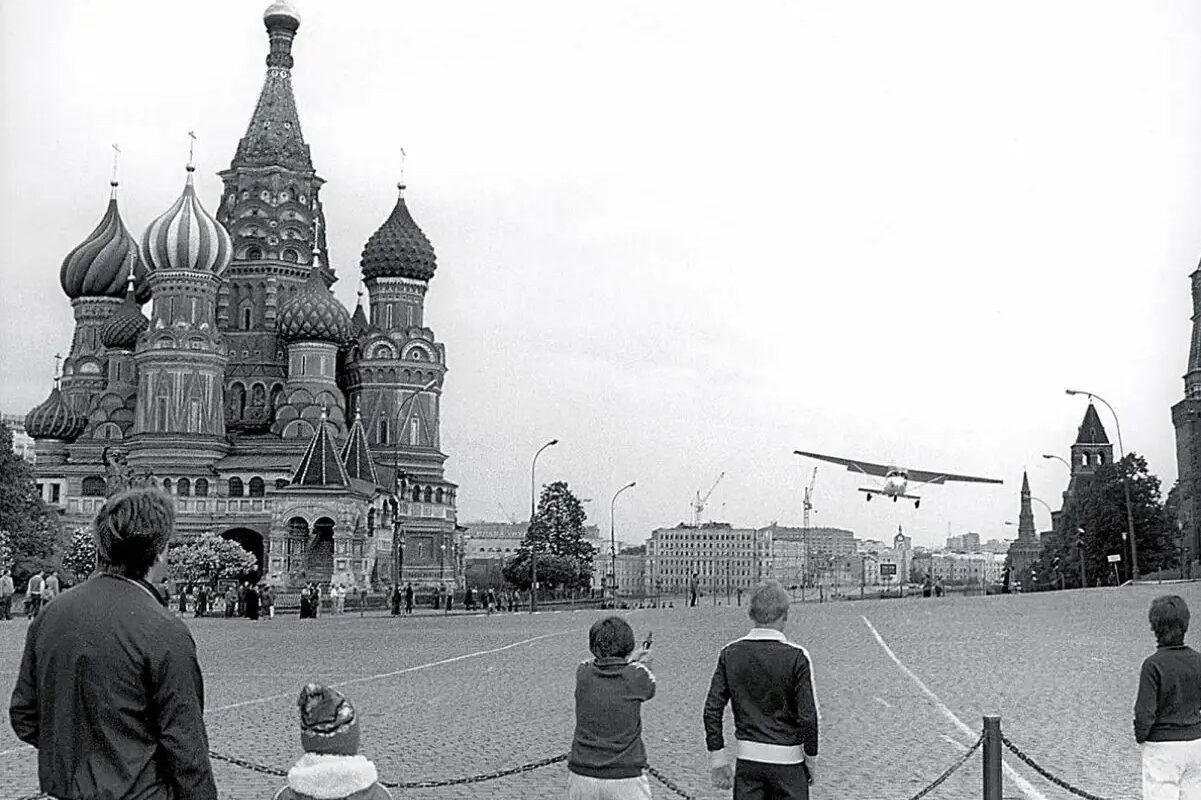
The West German pilot touches down near Red Square
Rust had originally hoped to land inside the Kremlin itself. But another thought crossed his mind: if he landed within such a heavily guarded compound, the KGB might quietly make him disappear before the outside world ever learned what had happened. If his mission was to deliver a message, someone had to witness it first. After circling Red Square, he realized the crowds below were too dense for a safe landing. Instead, he touched down on the nearby Bolshoy Moskvoretsky Bridge. Only afterward did investigators discover an extraordinary coincidence. The bridge’s overhead trolleybus wires had been temporarily removed that very day for routine maintenance and were scheduled to be reinstalled the following morning. Had they still been in place, Rust’s wings would likely have struck them, making the landing impossible.
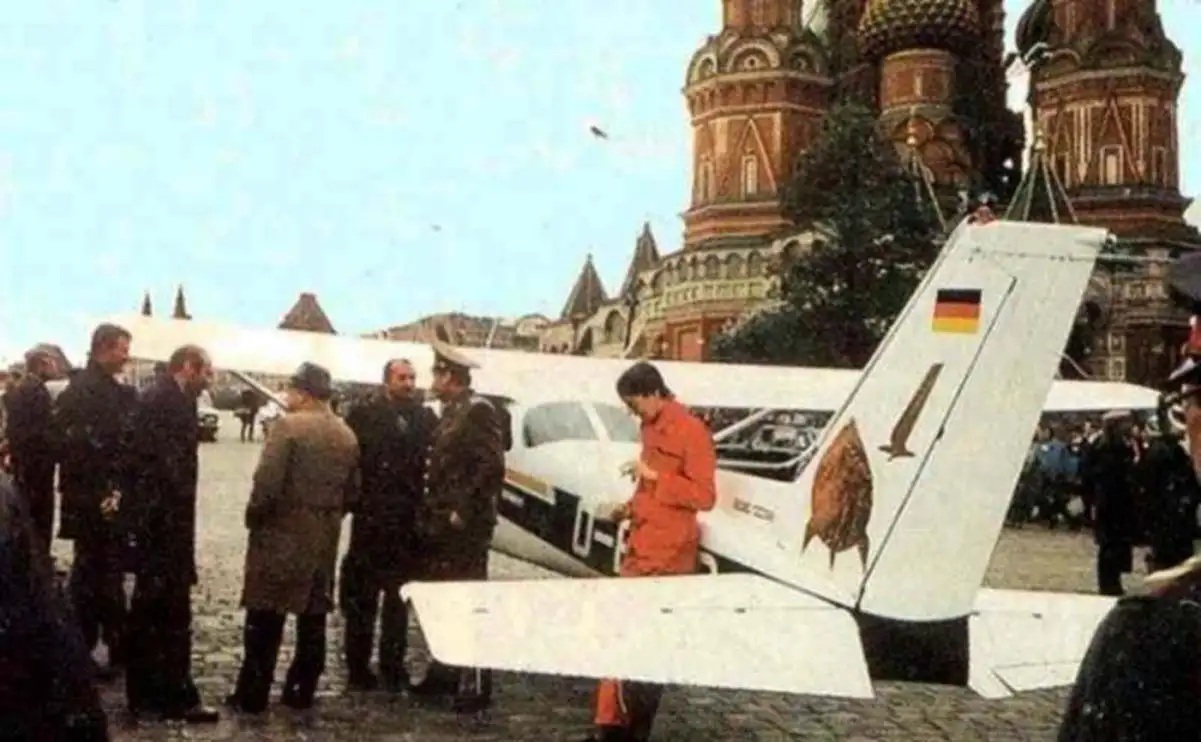
At around 7:00 p.m., he landed smoothly, taxied past the magnificent St. Basil’s Cathedral, and stopped only about one hundred meters from Red Square. With its brilliantly colored domes rising like flames against the sky, St. Basil’s Cathedral is among Russia’s most recognizable landmarks. For millions around the world, the sight of its vibrant onion domes immediately evokes the image of Russia itself.
The stunned Muscovites who gathered around the aircraft initially assumed they were witnessing the filming of an avant-garde movie. Some even approached the young pilot to ask for autographs and photographs. “Where are you from?” they asked. “Germany,” Rust replied. At first, many assumed he meant East Germany. When they realized he was from West Germany, their astonishment grew. It took nearly two hours before KGB agents and soldiers finally pushed through the crowd and arrested the young pilot whose small aircraft had embarrassed one of the world’s most powerful nations.
Rust was convicted of illegal border crossing, violating aviation regulations, and creating a public emergency. He received a four-year labor-camp sentence, but served only about fourteen months before Mikhail Gorbachev pardoned him as a gesture of goodwill. His release coincided with the signing of the Intermediate-Range Nuclear Forces (INF) Treaty, making him a small but memorable symbol of the improving relationship between East and West.
A single flight triggers massive political restructuring
Had the story ended there, it would have remained one of history’s most remarkable aviation anecdotes. But the little airplane had created shockwaves far beyond anything anyone anticipated. At the time, Mikhail Gorbachev was struggling to advance his ambitious reforms of glasnost (openness) and perestroika (restructuring), while facing strong resistance from conservative elements within the military. Rust’s flight unexpectedly gave him the leverage he needed. During a Politburo meeting, Gorbachev sharply criticized the military establishment. How could a defense system that had consumed enormous national resources fail to stop what was, in effect, a civilian hobby aircraft crossing hundreds of miles of protected airspace?
Faced with such a humiliating failure, the military’s conservative leadership had little defense. Marshal Sergei Sokolov, the Minister of Defense, was dismissed. Air Defense Commander Alexander Koldunov also lost his position. Hundreds of senior officers were removed in what became the largest military shake-up in the Soviet Union since Stalin’s purges of the 1930s. Former U.S. National Security Agency Director William Odom later argued that the incident caused lasting damage to the Soviet military’s prestige and authority.
History then added another remarkable irony. Sokolov’s successor was the younger Dmitry Yazov. Just four years later, Yazov became one of the principal leaders of the failed August 1991 coup — a final attempt by hardliners to preserve the rapidly collapsing Soviet system. On August 19, 1991, Yazov ordered tanks and airborne troops into Moscow. Together with seven other officials forming the State Committee on the State of Emergency (GKChP), he sought to remove Gorbachev while the Soviet leader was vacationing in Crimea. Yet the military, shaken and weakened after the Red Square incident, could not restore the old order.
Armored columns hesitated as they faced crowds of ordinary citizens. Meanwhile, Boris Yeltsin, then president of the Russian Republic, climbed onto a tank outside the Russian parliament and delivered a defiant speech. The image became one of the defining political photographs of the twentieth century. Two days later, Yazov ordered the troops to withdraw. The coup collapsed. Yazov was arrested, tried for treason, and remained under prosecution until receiving amnesty in 1994. The failed coup did not save the Soviet Union — it accelerated its collapse. Within a week, the Communist Party’s authority had been reduced to little more than a hollow institution. Less than four months later, the Soviet Union formally dissolved, disappearing from the world’s political map.
Unexpected acts reveal vulnerabilities in powerful systems
History rarely repeats itself in exactly the same way, and the Beijing incident should not be automatically equated with the events of 1987. Yet these two seemingly insignificant airplanes reveal a timeless truth: even the most powerful systems can contain unexpected vulnerabilities. A single individual, acting with determination, can sometimes accomplish what no outside force could — piercing a seemingly impenetrable barrier and exposing weaknesses hidden beneath the surface. When an unforeseen event reaches the very center of political power, its consequences can extend far beyond the moment itself.
The impact may not be understood immediately, but the questions it raises can keep shaping how people view authority, security, and the strength of the systems around them. History often reminds us that great changes do not always begin with armies, revolutions, or grand speeches. Sometimes they begin with a single unexpected act — one that reveals what was previously unseen and forces the world to reconsider what it believed to be unshakable.
Translated by Katy Liu and reviewed by Tatiana Denning
Follow us on X, Facebook, or Pinterest
