
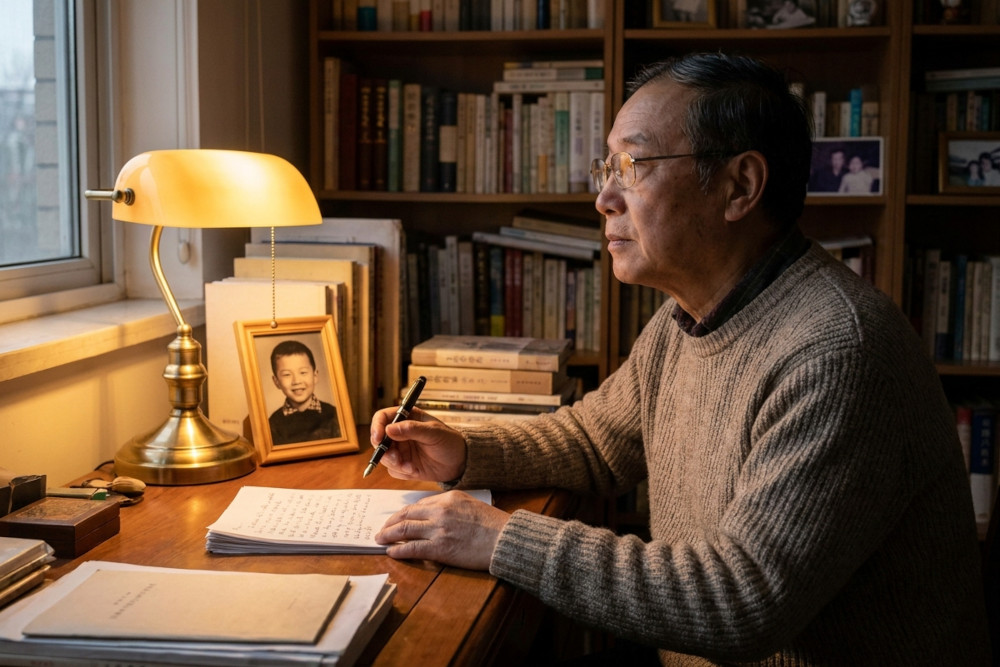
This is the kind of letter you can fold into a pocket and read again on a difficult evening, the kind a father writes when he wants his child to remember something. Liang Jizhang’s letter to his son is one of those.
Liang Jizhang (梁繼璋) is a Hong Kong radio host. Some years ago, he sat down and wrote a short, plain-spoken note to his child and titled it 給孩子的備忘錄, “Memo to My Child.” It moved through Chinese-language media, was later featured on Hong Kong’s TVB drama 情常在, and eventually crossed into English readers’ inboxes. People send it to their children. People send it to themselves.
His letter belongs to a tradition older than almost any other in Chinese culture: a father, late in his work or late in his life, sitting down to write his children a letter. Not a will. Not instructions. A letter. Nearly 2,000 years ago, the strategist Zhuge Liang Jizhang wrote his son a letter of just 86 characters on the discipline of stillness. In the Qing Dynasty (1644-1912), the official Zeng Guofan wrote nearly 1,500 letters home, building one of the most quoted family archives in Chinese history.
This is Liang Jizhang’s letter, and the man who wrote it.
Who is Liang Jizhang, the Hong Kong voice behind the letter
Liang Jizhang, born in 1957, is one of Hong Kong’s veteran broadcasters. He graduated from the Department of Communication at Hong Kong Baptist College in 1979 and has built a long career on Hong Kong radio as a DJ, host, and writer. For decades, he has been a familiar voice on the city’s airwaves.
Hong Kong’s radio culture has always been intimate. Long shows, late hours, a host speaking to an audience that often listens alone in a car or a small flat. That intimacy seems to thread through Liang Jizhang’s writing, too. The original Chinese title of his letter, 給孩子的備忘錄 (Gěi Háizi de Bèiwànglù), is sometimes translated as “Note to My Child” or “Memo to My Son.” The word bèiwànglù (備忘錄) literally means “memorandum”, something you write down so you don’t forget. There is no grand framing here. This is a father putting things on paper while he can.
The letter began circulating in Chinese-language media in the early 2000s and was later popularized through television. The English version most commonly shared online was translated by Chua BC and circulated by NTD Television.
A tradition of Chinese fathers writing to their sons
Letters like Liang Jizhang’s belong to a long lineage. The Chinese language has its own word for the genre, 家書 (jiāshū), literally “family letter.” For centuries, a father’s written words to his children carried something rituals could not: a record of what one generation hoped the next would understand.
Two famous voices stand at either end of that lineage.
The first is Zhuge Liang (A.D. 181-234), the celebrated statesman and military strategist of the Three Kingdoms period. Just before his death, he wrote a letter to his son known as 戒子書 (Jiè Zǐ Shū), “A Letter of Admonition to My Son.” It is only 86 Chinese characters long. In it, he warned that “without stillness, one cannot reach what is far,” and that without study, a person cannot expand their talents. More than 17 centuries later, Chinese students still memorize it.
The second is Zeng Guofan (1811-1872), a Qing Dynasty official whose family letters fill multiple volumes. Of the nearly 1,500 letters that survive, 12 were written to his eldest son Zeng Jize between 1852 and 1865. They cover everything from how to rise early, how to study, how to manage household relationships, and how to be a person of decency in a chaotic time. Generations later, Chinese readers still treat 曾國藩家書 as a manual for raising a child.
Liang Jizhang’s letter sits inside this lineage, not as a classical text, but as a modern continuation of it. The setting has changed (a radio host, not a general or an official), the language is everyday rather than literary, but the impulse is the same. A father writing down what he hopes his child remembers when he is no longer there to say it.
You can see a similar thread running through other Chinese family stories Nspirement has covered, from the story of Mencius’s mother and the three moves that shaped a philosopher to ancient Tang Dynasty stories of loyalty and humility.
The letter, Liang Jizhang’s nine reflections to his son
What follows is Liang Jizhang’s letter to his son, presented here with light polish for clarity. The voice is Liang Jizhang’s own: spare, unsentimental, sometimes blunt. There are nine reflections, and they read like a father saying things he is not sure he will get to say again.
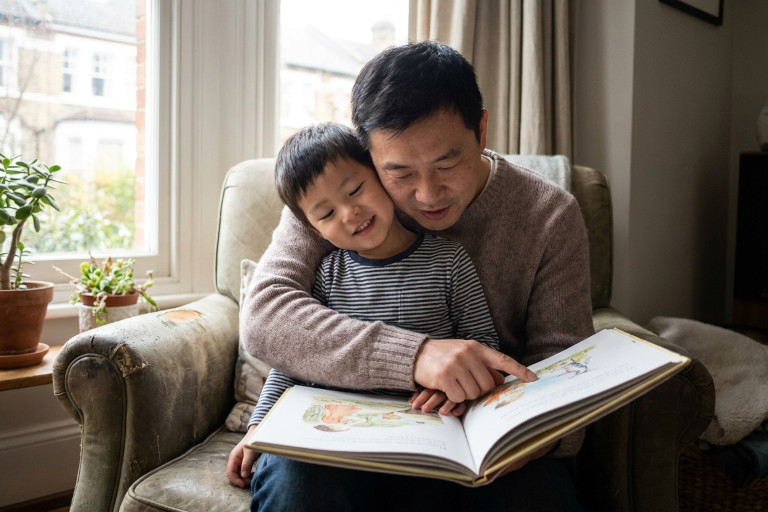
(Image: via Nano Banana)
1. Nobody is obliged to treat you well, except your mother and me.
For those who are good to you, treasure them and be grateful. But also remember this: you do not always know why someone is being kind to you. Often, there is something behind it. Do not rush to call any new acquaintance a true friend.
2. Nobody is indispensable. Nothing is essential to possess.
When you understand this, life becomes easier later, when people you love are no longer there, when things you care about slip away.
3. Life is short.
Today you may waste an afternoon, and tomorrow you will realize it’s gone for good. The earlier you cherish your life, the more of it you will get to enjoy. Hoping to live a long time matters less than living fully now.
4. Love is a feeling, and feelings change with time.
When the person you love no longer loves you, step back patiently and let time do its work. Do not force the heart of another. And do not let your own heart be ruined by the loss.
5. Although many successful people did not have much formal education, this does not mean you can succeed without studying.
Knowledge is a tool you will use for the rest of your life. The work you put into learning is work you do for your own future, not for me or anyone else.
6. I do not expect you to support me in my old age, and I will not be able to support you forever.
When you are grown, the path ahead is yours. Whether you walk it well, that, too, will be yours.
7. You can ask yourself to be a person of integrity, but you cannot demand that others be the same.
You can treat others with kindness, but you cannot expect that they will treat you the same way. If you forget this, you will be hurt without end.
8. I have bought lottery tickets for many years, and I am still poor.
If a person wants to prosper, they have to work for it. There is no free lunch in this world.
9. We are connected as family in this life, however brief or long that turns out to be.
The Buddhist tradition speaks of 緣分 (yuánfèn), the fated thread that binds two people together. Whatever time we have together, please cherish it. We may not meet again in another life.
Why this letter resonates: A father’s love in plain words
What makes this letter travel? Why has it moved readers across cultures, languages, and decades?
Part of it is the voice. Most modern parenting writing is therapeutic in tone, soft, careful, and gentle in its phrasing. Liang Jizhang’s letter is not. It is closer to the register of an older Chinese moralist: matter-of-fact, almost stoic, willing to say the hard thing without dressing it up. He tells his son that no one owes him kindness. He tells his son not to expect to be repaid for being good. He tells his son that he, the father, will not always be there. There is love in every line, but it is the love of someone who knows that softness alone will not protect a child from the world.
Underneath the plain language is a quietly Confucian frame. Several of the letter’s lessons map onto traditional Chinese virtues: xin (信, sincerity and trustworthiness) when he tells his son to be a person of integrity; xiao (孝, filial gratitude) when he says only parents are obliged to love unconditionally; the long Confucian emphasis on study and self-cultivation when he insists that knowledge is a tool no one can take from you. For more on how these virtues shape Chinese life and storytelling, see Nspirement’s stories on the power of virtue.
There is a Buddhist current, too. The line about yuánfèn, the thread of fated connection, is rooted in the Buddhist understanding of impermanence. Nothing lasts. People meet, and people part. To love what is in front of you while it is in front of you is the practice of a lifetime.
And then there is the most personal reason this letter travels: nearly everyone who reads it is, at some point, either the parent or the child in it. We have all loved imperfectly. We have all been loved imperfectly. A letter that names that, plainly, makes room for the rest of our living.
What Liang Jizhang’s letter asks of you
If a letter like this is going to do anything, it has to be lived rather than read. So before this article ends, three small invitations the letter quietly offers any reader:
Tell someone who has been good to you that you noticed. Not a grand thank-you. A small one. The first lesson of the letter, that no one is obliged to treat you well, only becomes hopeful, rather than cold, when you act on it. Gratitude is a verb.
Spend an unhurried hour with a parent or child while you can. Not when there is a crisis. Not when someone is leaving. Now, while there is nothing in particular happening. The letter’s last line about yuánfèn is a reminder that time together is the only thing we ever actually own.
Let one disappointment with someone else’s behavior soften. The seventh lesson, that you cannot demand integrity from others, only from yourself, is the most freeing thing in the whole letter. The person who hurt you may never become the person you wished they were. Putting that down is its own kind of peace.
For more reflections in this voice, explore Nspirement’s Humankind stories, or read more on the quiet weight of family and relationships.
A final thought
Liang Jizhang’s letter to his son is not a manual. It is not a list of rules. It is a record of what one Hong Kong father wanted his son to remember on a day when he, the father, would not be there to remind him. That is what makes it survive translation, generation, and time.
The Chinese tradition of family letters, from Zhuge Liang’s stillness to Zeng Guofan’s discipline to Liang Jizhang’s plain affection, exists because what we owe each other is gentler and harder than we usually think. Show gratitude where it is real. Cherish the people you have while you have them. Do the work of becoming a person of integrity, and stop asking the same of others.
If this letter does anything for you, let it be that.
Translated by Chua BC
Follow us on X, Facebook, or Pinterest
